양자 근사 최적화 알고리즘
사용 시간 예상: Heron r3 프로세서 기준 22분 (참고: 이는 예상치이며 실제 실행 시간은 다를 수 있습니다.)
학습 성과
-
고전적 조합 최적화 문제(max-cut)를 양자 Hamiltonian으로 매핑하는 방법
-
IBM Quantum Compute Service Session을 사용하여 양자 근사 최적화 알고리즘(QAOA)을 구현하고 실행하는 방법
-
작은 시뮬레이터 예제에서 유틸리티 규모의 하드웨어 실행으로 QAOA 워크플로를 확장하는 방법
사전 준비 사항
-
QAOA 심화 — QAOA 알고리즘에 대한 포괄적인 설명과 유틸리티 규모에서의 적용
배경
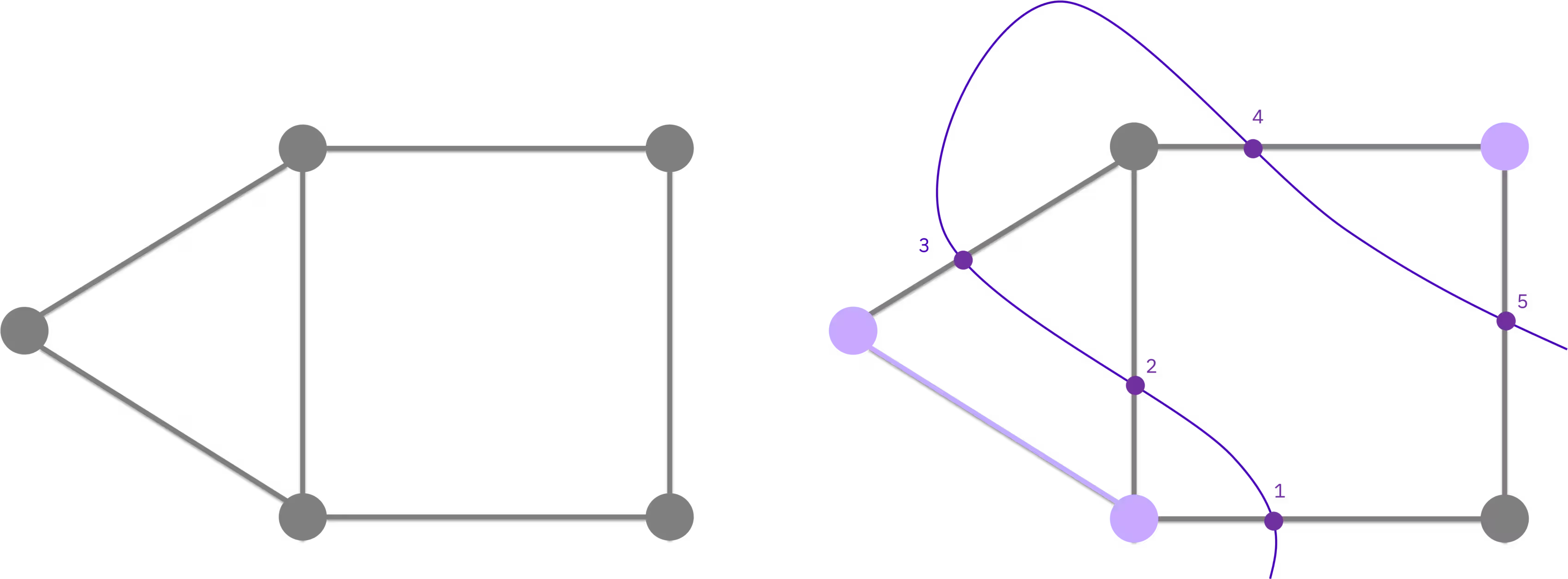
**양자 근사 최적화 알고리즘(Quantum Approximate Optimization Algorithm, QAOA)**은 조합 최적화 문제를 해결하기 위한 하이브리드 양자-고전 반복 방법입니다. 이 튜토리얼에서는 QAOA를 사용하여 최대 컷(maximum-cut, max-cut) 문제 — 클러스터링, 네트워크 과학, 통계 물리학 등에 응용되는 NP-hard 최적화 문제 — 를 해결합니다. 엣지로 연결된 노드로 구성된 그래프가 주어졌을 때, 목표는 분할을 가로지르는 엣지의 수가 최대화되도록 노드를 두 집합으로 나누는 것입니다.
조합 최적화는 연료 사용을 줄이기 위한 배송 경로 계획이나 자재 낭비를 제한하기 위한 자원 할당과 같은 지속가능성 과제에서도 나타납니다. 최대 절단(max-cut) 예제는 목적 함수를 비용 해밀토니안으로 표현하고 QAOA를 사용하여 후보 해를 탐색하는 과정을 소개합니다. 이 접근 방식을 지속가능성 문제에 적용하려면 의도한 응용을 나타내는 목적 함수와 제약 조건이 필요합니다.
고전적 최적화에서 양자 Circuit으로
Max-cut은 고전적인 이진 최적화 문제로 표현될 수 있습니다. 각 노드에는 어느 집합에 속하는지를 나타내는 이진 변수 가 할당됩니다. 목표는 양 끝점이 서로 다른 집합에 속하는 엣지의 수를 최대화하는 것입니다:
이는 동등하게 형태의 이차 비제약 이진 최적화(Quadratic Unconstrained Binary Optimization, QUBO) 문제입니다. 표준적인 변수 치환()을 통해 QUBO는 기저 상태가 최적해를 인코딩하는 비용 Hamiltonian으로 다시 쓸 수 있습니다. 일반적으로 이 Hamiltonian은 이차 항과 선형 항을 모두 가집니다:
여기서 고려하는 비가중 max-cut 문제의 경우 선형 계수가 소멸하고() 각 엣지에 대해 이므로, 아래 코드에서 구축할 더 간단한 형태 가 남습니다. 위의 더 일반적인 형태는 이 워크플로를 가중 그래프나 기타 QUBO로 표현 가능한 문제에 적용하려고 할 때 필요한 형태입니다.
QAOA의 작동 방식
QAOA는 초기 중첩 상태 에 두 연산자의 교대 레이어를 적용하여 후보 해를 준비합니다: 비용 연산자 와 믹서 연산자 입니다. 각도 와 는 고전적 피드백 루프에서 최적화됩니다. 양자 컴퓨터가 비용 함수를 평가하고, 고전적 최적화기는 수렴할 때까지 파라미터를 업데이트합니다. 이 반복 루프는 Quantum Compute session 내에서 실행되며, 이는 반복 전반에 걸쳐 양자 장치를 예약 상태로 유지하여 지연 시간을 낮춥니다.
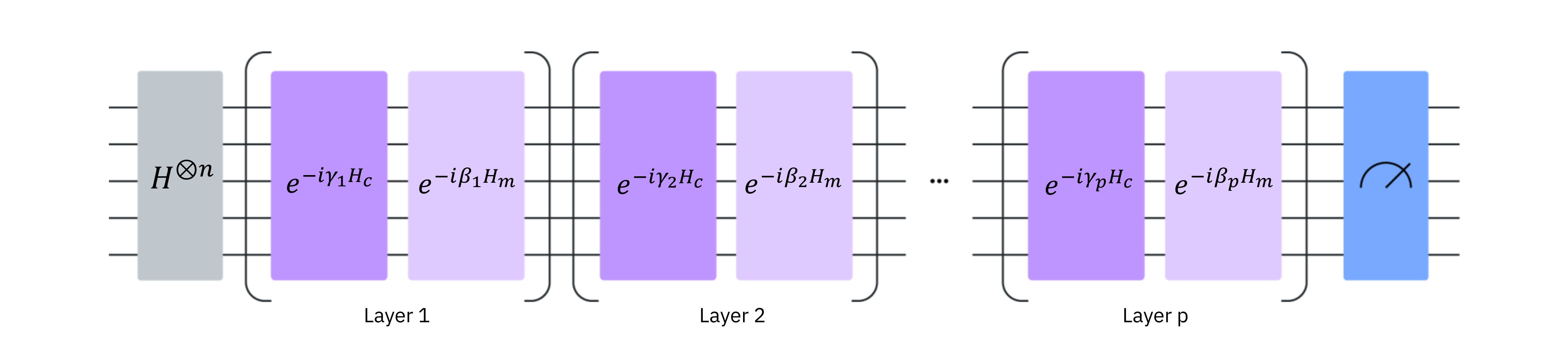
전체 QUBO-Hamiltonian 유도를 포함한 QAOA 이론에 대한 더 깊은 설명은 QAOA 코스 모듈을 참고하세요.
이 튜토리얼에서는 먼저 작은 5-노드 그래프에서 max-cut을 해결한 다음, 동일한 워크플로를 실제 하드웨어의 100-노드 유틸리티 규모 문제로 확장합니다. 플랜 접근에 대한 참고: 이 튜토리얼은 Quantum Compute sessions을 사용하며, 이는 Premium Plan에서만 사용할 수 있습니다. Open Plan을 사용하는 경우 작성된 그대로 이 튜토리얼을 실행할 수 없습니다. 대신 Session을 job 모드로 교체해야 합니다(즉, 최적화 루프를 with Session(...)으로 감싸는 대신 각 반복을 독립적인 작업으로 제출). 워크플로는 여전히 실행되지만, 예약된 장치를 재사용하는 대신 각 반복이 전체 대기열 지연 시간을 겪게 됩니다. 자세한 내용은 사용 가능한 플랜 개요를 참고하세요.
요구 사항
이 튜토리얼을 시작하기 전에 다음이 설치되어 있는지 확인하세요:
-
Qiskit SDK v2.0 이상 (시각화 지원 포함)
-
Qiskit Runtime v0.22 이상 (
pip install qiskit-ibm-runtime)
또한 IBM Quantum® Platform의 인스턴스에 접근 권한이 필요합니다.
설정
# Added by doQumentation — required packages for this notebook
!pip install -q matplotlib numpy qiskit qiskit-ibm-runtime rustworkx scipy
import matplotlib.pyplot as plt
import rustworkx as rx
from rustworkx.visualization import mpl_draw as draw_graph
import numpy as np
from scipy.optimize import minimize
from collections import defaultdict
from typing import Sequence

from qiskit.quantum_info import SparsePauliOp
from qiskit.circuit.library import QAOAAnsatz
from qiskit.transpiler.preset_passmanagers import generate_preset_pass_manager

from qiskit_ibm_runtime import QiskitRuntimeService
from qiskit_ibm_runtime import Session, EstimatorV2 as Estimator
from qiskit_ibm_runtime import SamplerV2 as Sampler
소규모 예제
이 섹션에서는 작은 5-노드 max-cut 인스턴스에서 QAOA 워크플로의 각 단계를 살펴봅니다. "소규모"라는 이름과 달리 이 예제도 실제 IBM Quantum 하드웨어에서 실행됩니다 — 코드는 127개 이상의 Qubit을 가진 Backend를 선택하고 거기서 Circuit을 실행합니다. 개의 노드를 가진 그래프를 생성하여 문제를 초기화합니다.
n_small = 5

graph = rx.PyGraph()
graph.add_nodes_from(np.arange(0, n_small, 1))
edge_list = [
    (0, 1, 1.0),
    (0, 2, 1.0),
    (0, 4, 1.0),
    (1, 2, 1.0),
    (2, 3, 1.0),
    (3, 4, 1.0),
]
graph.add_edges_from(edge_list)
draw_graph(graph, node_size=600, with_labels=True)

Step 1: 고전적 입력을 양자 문제로 매핑하기
고전적 그래프를 양자 Circuit과 연산자로 매핑합니다. 배경에서 설명한 대로, 비가중 max-cut의 경우 비용 Hamiltonian은 로 축소되며, QAOA는 매개변수화된 ansatz Circuit을 사용하여 의 후보 기저 상태를 준비합니다.
비용 Hamiltonian 구축
그래프 엣지를 Pauli 항으로 변환하여 를 구축합니다(배경에서 유도 참고).
def build_max_cut_paulis(
    graph: rx.PyGraph,
) -> list[tuple[str, list[int], float]]:
    """Convert graph edges to a list of ZZ Pauli terms.

    The returned list is in the sparse format expected by
    ``SparsePauliOp.from_sparse_list``: each element is
    ``(pauli_string, qubit_indices, coefficient)``.
    """
    pauli_list = []
    for edge in list(graph.edge_list()):
        weight = graph.get_edge_data(edge[0], edge[1])
        pauli_list.append(("ZZ", [edge[0], edge[1]], weight))
    return pauli_list

max_cut_paulis = build_max_cut_paulis(graph)
cost_hamiltonian = SparsePauliOp.from_sparse_list(max_cut_paulis, n_small)
print("Cost Function Hamiltonian:", cost_hamiltonian)
Cost Function Hamiltonian: SparsePauliOp(['IIIZZ', 'IIZIZ', 'ZIIIZ', 'IIZZI', 'IZZII', 'ZZIII'],
              coeffs=[1.+0.j, 1.+0.j, 1.+0.j, 1.+0.j, 1.+0.j, 1.+0.j])
QAOA ansatz Circuit 구축
QAOAAnsatz를 사용하여 비용 Hamiltonian으로부터 매개변수화된 QAOA Circuit을 구축합니다. 여기서는 reps=2(두 개의 QAOA 레이어, 네 개의 파라미터: )를 사용합니다.
circuit = QAOAAnsatz(cost_operator=cost_hamiltonian, reps=2)
circuit.measure_all()

circuit.draw("mpl")

circuit.parameters
ParameterView([ParameterVectorElement(β[0]), ParameterVectorElement(β[1]), ParameterVectorElement(γ[0]), ParameterVectorElement(γ[1])])
Step 2: 양자 하드웨어 실행을 위한 문제 최적화
추상적인 Circuit을 하드웨어 네이티브 명령어로 트랜스파일합니다. 이 단계는 qubit 매핑, Gate 분해, 라우팅, 오류 억제를 처리합니다. 자세한 내용은 트랜스파일 문서를 참고하세요.
service = QiskitRuntimeService()
backend = service.least_busy(
    operational=True, simulator=False, min_num_qubits=127
)
print(backend)

# Create pass manager for transpilation. Level 3 is the most aggressive
# preset: slower to transpile, but produces shorter circuits that are
# more robust to hardware noise.
pm = generate_preset_pass_manager(optimization_level=3, backend=backend)

candidate_circuit = pm.run(circuit)
candidate_circuit.draw("mpl", fold=False, idle_wires=False)
<IBMBackend('ibm_pittsburgh')>

Step 3: Qiskit 프리미티브를 사용하여 실행
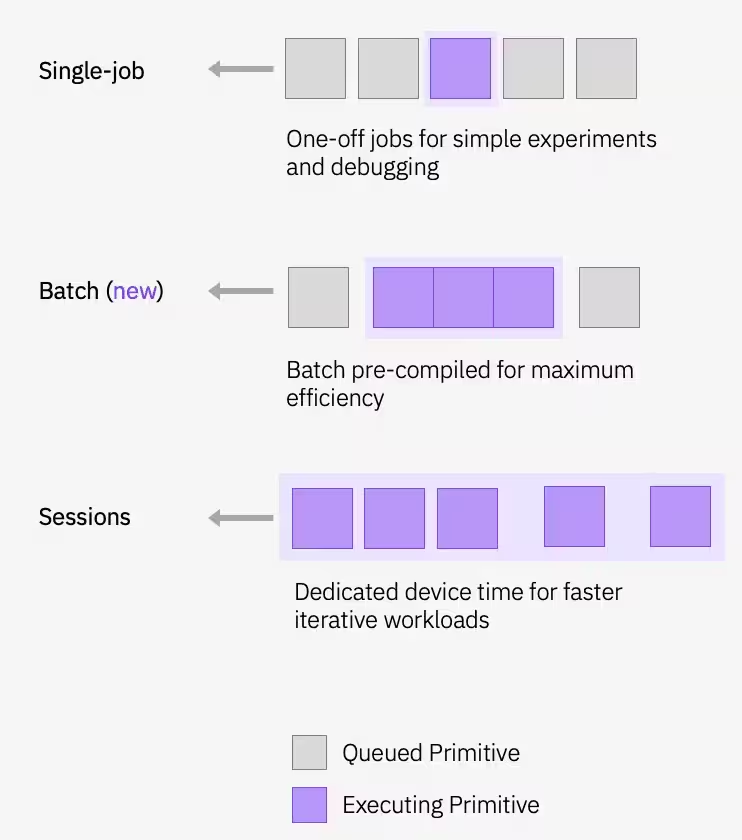
QAOA 최적화 루프는 반복 전반에 걸쳐 장치를 예약 상태로 유지하기 위해 Quantum Compute session 내에서 실행됩니다. Estimator는 각 단계에서 를 평가하고, 고전적 최적화기(COBYLA)는 수렴할 때까지 파라미터를 업데이트합니다.
 초기 파라미터를 정의하고 최적화 루프를 실행합니다:
# QAOA doesn't prescribe principled default angles — any bounded choice
# works as a warm start for problems this small. beta and gamma are
# periodic (beta in [0, pi] and gamma in [0, 2*pi] modulo the underlying
# Pauli-rotation periods), and pi/2 and pi are just midpoints of those
# ranges. For harder problems you would typically warm start from known
# good angles or transfer parameters from smaller instances.
initial_gamma = np.pi
initial_beta = np.pi / 2
init_params = [initial_beta, initial_beta, initial_gamma, initial_gamma]
def cost_func_estimator(params, ansatz, hamiltonian, estimator):
    # transform the observable defined on virtual qubits to
    # an observable defined on all physical qubits
    isa_hamiltonian = hamiltonian.apply_layout(ansatz.layout)

    pub = (ansatz, isa_hamiltonian, params)
    job = estimator.run([pub])

    results = job.result()[0]
    cost = results.data.evs

    objective_func_vals.append(cost)

    return cost
objective_func_vals = []  # Global variable
with Session(backend=backend) as session:
    # If using qiskit-ibm-runtime<0.24.0, change `mode=` to `session=`
    estimator = Estimator(mode=session)
    estimator.options.default_shots = 1000

    # Set simple error suppression/mitigation options
    estimator.options.dynamical_decoupling.enable = True
    estimator.options.dynamical_decoupling.sequence_type = "XY4"
    estimator.options.twirling.enable_gates = True
    estimator.options.twirling.num_randomizations = "auto"
    estimator.options.environment.job_tags = ["TUT_QAOA"]

    result = minimize(
        cost_func_estimator,
        init_params,
        args=(candidate_circuit, cost_hamiltonian, estimator),
        method="COBYLA",
        tol=1e-2,
    )
    print(result)
message: Return from COBYLA because the trust region radius reaches its lower bound.
 success: True
  status: 0
     fun: -2.0402211719947774
       x: [ 3.041e+00  1.212e+00  2.081e+00  4.471e+00]
    nfev: 36
   maxcv: 0.0
최적화기가 비용을 줄이고 Circuit에 더 나은 파라미터를 찾는 데 성공했습니다.
부드럽게 감소하여 평탄해지는 곡선은 수렴의 특징입니다. 노이즈가 많고 단조롭지 않은 곡선은 대개 앞 단계에 손볼 것이 있다는 신호입니다. 일반적인 원인으로는 평가당 샷 수가 너무 적거나(추정량 분산이 큼), 초기 파라미터가 좋지 않거나, 깊이가 하드웨어 노이즈에 지배되는 Circuit 등이 있습니다. COBYLA는 미분이 필요 없으며 적당한 노이즈에는 상당히 강건하지만, 노이즈가 단계당 실제 비용 개선을 압도하면 선형 근사 모델이 더 이상 실제 하강과 무작위 흔들림을 구분하지 못해 최적화기가 엉뚱한 방향으로 헤매게 됩니다.
plt.figure(figsize=(12, 6))
plt.plot(objective_func_vals)
plt.xlabel("Iteration")
plt.ylabel("Cost")
plt.show()

최적화된 파라미터를 할당하고 Sampler 프리미티브를 사용하여 최종 분포를 샘플링합니다.
optimized_circuit = candidate_circuit.assign_parameters(result.x)
optimized_circuit.draw("mpl", fold=False, idle_wires=False)

# If using qiskit-ibm-runtime<0.24.0, change `mode=` to `backend=`
sampler = Sampler(mode=backend)
sampler.options.default_shots = 10000

# Set simple error suppression/mitigation options
sampler.options.dynamical_decoupling.enable = True
sampler.options.dynamical_decoupling.sequence_type = "XY4"
sampler.options.twirling.enable_gates = True
sampler.options.twirling.num_randomizations = "auto"

sampler.options.environment.job_tags = ["TUT_QAOA"]

pub = (optimized_circuit,)
job = sampler.run([pub], shots=int(1e4))
counts_int = job.result()[0].data.meas.get_int_counts()
counts_bin = job.result()[0].data.meas.get_counts()
shots = sum(counts_int.values())
final_distribution_int = {key: val / shots for key, val in counts_int.items()}
final_distribution_bin = {key: val / shots for key, val in counts_bin.items()}
print(final_distribution_int)
{18: 0.039, 5: 0.0665, 20: 0.0973, 29: 0.0063, 9: 0.0899, 13: 0.0379, 2: 0.0047, 1: 0.0153, 11: 0.0932, 14: 0.0327, 12: 0.0314, 25: 0.0193, 21: 0.0398, 6: 0.0224, 4: 0.0197, 10: 0.0387, 3: 0.0181, 26: 0.07, 17: 0.0327, 19: 0.0332, 22: 0.0914, 24: 0.007, 0: 0.0033, 8: 0.0066, 30: 0.0158, 28: 0.0169, 27: 0.0222, 16: 0.0073, 7: 0.0057, 23: 0.0062, 15: 0.0054, 31: 0.0041}
Step 4: 사후 처리하고 원하는 고전적 형식으로 결과 반환
샘플링된 분포에서 가장 가능성이 높은 비트스트링을 추출합니다. 이는 QAOA가 찾아낸 가장 좋은 컷을 나타냅니다.
# auxiliary functions to sample most likely bitstring
def to_bitstring(integer, num_bits):
    result = np.binary_repr(integer, width=num_bits)
    return [int(digit) for digit in result]

keys = list(final_distribution_int.keys())
values = list(final_distribution_int.values())
most_likely = keys[np.argmax(np.abs(values))]
most_likely_bitstring = to_bitstring(most_likely, len(graph))
most_likely_bitstring.reverse()

print("Result bitstring:", most_likely_bitstring)
Result bitstring: [0, 0, 1, 0, 1]
plt.rcParams.update({"font.size": 10})
final_bits = final_distribution_bin
values = np.abs(list(final_bits.values()))
top_4_values = sorted(values, reverse=True)[:4]
positions = []
for value in top_4_values:
    positions.append(np.where(values == value)[0])
fig = plt.figure(figsize=(11, 6))
ax = fig.add_subplot(1, 1, 1)
plt.xticks(rotation=45)
plt.title("Result Distribution")
plt.xlabel("Bitstrings (reversed)")
plt.ylabel("Probability")
ax.bar(list(final_bits.keys()), list(final_bits.values()), color="tab:grey")
for p in positions:
    ax.get_children()[int(p[0])].set_color("tab:purple")
plt.show()

가장 좋은 컷 시각화
최적의 비트스트링으로부터 이 컷을 원래 그래프 위에 시각화할 수 있습니다.
# auxiliary function to plot graphs
def plot_result(G, x):
    colors = ["tab:grey" if i == 0 else "tab:purple" for i in x]
    pos, _default_axes = rx.spring_layout(G), plt.axes(frameon=True)
    rx.visualization.mpl_draw(
        G, node_color=colors, node_size=100, alpha=0.8, pos=pos
    )

plot_result(graph, most_likely_bitstring)

이제 컷의 값을 계산합니다:
def evaluate_sample(x: Sequence[int], graph: rx.PyGraph) -> float:
    assert len(x) == len(
        list(graph.nodes())
    ), "The length of x must coincide with the number of nodes in the graph."
    return sum(
        x[u] * (1 - x[v]) + x[v] * (1 - x[u])
        for u, v in list(graph.edge_list())
    )

cut_value = evaluate_sample(most_likely_bitstring, graph)
print("The value of the cut is:", cut_value)
The value of the cut is: 5
이렇게 작은 그래프의 경우 진정한 최적값을 무차별 대입으로 쉽게 구할 수 있으므로, QAOA 결과를 정확한 답과 비교하여 결과를 다시 확인할 수 있습니다.
# Classical baseline: enumerate all 2**n_small bitstrings and take the best cut.
def brute_force_max_cut(graph: rx.PyGraph) -> tuple[int, list[int]]:
    n = len(list(graph.nodes()))
    best_cut = -1
    best_x: list[int] = []
    for i in range(2**n):
        x = [(i >> k) & 1 for k in range(n)]
        cut = evaluate_sample(x, graph)
        if cut > best_cut:
            best_cut = int(cut)
            best_x = x
    return best_cut, best_x

classical_best, classical_x = brute_force_max_cut(graph)
print(f"Classical optimum (brute force): {classical_best}")
print(f"QAOA cut value:                  {cut_value}")
Classical optimum (brute force): 5
QAOA cut value:                  5
대규모 하드웨어 예제
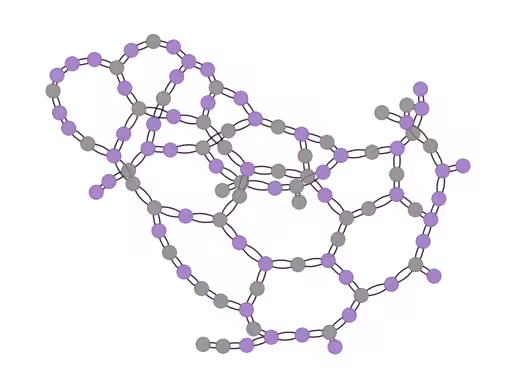
IBM Quantum Platform에서 100개 이상의 Qubit을 가진 많은 장치에 접근할 수 있습니다. 100-노드 가중 그래프에서 max-cut을 해결할 장치를 하나 선택하세요. 이것은 "유틸리티 규모" 문제입니다. 워크플로는 위와 동일한 단계를 따르며, 훨씬 더 큰 그래프에 적용됩니다.
유틸리티 규모의 종단 간 워크플로
네 단계 모두 아래에 100-노드 그래프에 적용되어 표시됩니다. 구조는 소규모 설명과 동일합니다: 매핑, 트랜스파일, 실행, 사후 처리 — 다만 더 큰 문제이며 명확성을 위해 아래 네 개의 셀로 나뉘어 있습니다.
# Precomputed parity lookup table: _PARITY[b] = +1 if popcount(b) is even, else -1.
# We use this to vectorize expectation-value evaluation across all Pauli terms.
_PARITY = np.array(
    [-1 if bin(i).count("1") % 2 else 1 for i in range(256)],
    dtype=np.complex128,
)

def evaluate_sparse_pauli(state: int, observable: SparsePauliOp) -> complex:
    """Expectation value of a SparsePauliOp on a single computational-basis state.

    For a Z-only observable (which QAOA cost Hamiltonians are, after the
    QUBO-to-Hamiltonian mapping), the eigenvalue of each Pauli term on a
    computational-basis state is simply (-1)**popcount(z_mask AND state),
    i.e., the parity of the bitwise-AND of the term's Z-support and the
    measured bitstring.

    This routine packs the Z-support of every Pauli term into bytes, ANDs
    them against the measured state in a single vectorized op, and looks up
    the parity in _PARITY. For a 100-qubit / ~hundreds-of-terms Hamiltonian
    over 10_000 samples, this is dramatically faster than calling
    SparsePauliOp.expectation_value per sample.
    """
    packed_uint8 = np.packbits(observable.paulis.z, axis=1, bitorder="little")
    state_bytes = np.frombuffer(
        state.to_bytes(packed_uint8.shape[1], "little"), dtype=np.uint8
    )
    reduced = np.bitwise_xor.reduce(packed_uint8 & state_bytes, axis=1)
    return np.sum(observable.coeffs * _PARITY[reduced])

def best_solution(samples, hamiltonian):
    """Return the sampled bitstring (as int) with the lowest Hamiltonian cost."""
    min_cost = float("inf")
    min_sol = None
    for bit_str in samples.keys():
        candidate_sol = int(bit_str)
        fval = evaluate_sparse_pauli(candidate_sol, hamiltonian).real
        if fval <= min_cost:
            min_cost = fval
            min_sol = candidate_sol
    return min_sol

def _plot_cdf(objective_values: dict, ax, color):
    x_vals = sorted(objective_values.keys(), reverse=True)
    y_vals = np.cumsum([objective_values[x] for x in x_vals])
    ax.plot(x_vals, y_vals, color=color)

def plot_cdf(dist, ax, title):
    _plot_cdf(dist, ax, "C1")
    ax.vlines(min(list(dist.keys())), 0, 1, "C1", linestyle="--")
    ax.set_title(title)
    ax.set_xlabel("Objective function value")
    ax.set_ylabel("Cumulative distribution function")
    ax.grid(alpha=0.3)

def samples_to_objective_values(samples, hamiltonian):
    """Convert the samples to values of the objective function."""
    objective_values = defaultdict(float)
    for bit_str, prob in samples.items():
        candidate_sol = int(bit_str)
        fval = evaluate_sparse_pauli(candidate_sol, hamiltonian).real
        objective_values[fval] += prob
    return objective_values
Step 1: 그래프, 비용 Hamiltonian, ansatz를 구축합니다.
# Step 1: build the 100-node graph, cost Hamiltonian, and QAOA ansatz.
n_large = 100
graph_100 = rx.PyGraph()
graph_100.add_nodes_from(np.arange(0, n_large, 1))
elist = []
for edge in backend.coupling_map:
    if edge[0] < n_large and edge[1] < n_large:
        elist.append((edge[0], edge[1], 1.0))
graph_100.add_edges_from(elist)

max_cut_paulis_100 = build_max_cut_paulis(graph_100)
cost_hamiltonian_100 = SparsePauliOp.from_sparse_list(
    max_cut_paulis_100, n_large
)

circuit_100 = QAOAAnsatz(cost_operator=cost_hamiltonian_100, reps=1)
circuit_100.measure_all()
Step 2: 선택한 하드웨어 Backend에 맞게 트랜스파일합니다.
# Step 2: transpile for hardware.
pm = generate_preset_pass_manager(optimization_level=3, backend=backend)
candidate_circuit_100 = pm.run(circuit_100)
Step 3: Session 내에서 QAOA 최적화 루프를 실행한 다음 샘플링합니다.
# Step 3: run the QAOA optimization loop on the device, then sample the
# final distribution with the optimized parameters.
initial_gamma = np.pi
initial_beta = np.pi / 2
init_params = [initial_beta, initial_gamma]

objective_func_vals = []  # Global variable
with Session(backend=backend) as session:
    estimator = Estimator(mode=session)
    estimator.options.default_shots = 1000

    # Set simple error suppression/mitigation options
    estimator.options.dynamical_decoupling.enable = True
    estimator.options.dynamical_decoupling.sequence_type = "XY4"
    estimator.options.twirling.enable_gates = True
    estimator.options.twirling.num_randomizations = "auto"
    estimator.options.environment.job_tags = ["TUT_QAOA"]

    result = minimize(
        cost_func_estimator,
        init_params,
        args=(candidate_circuit_100, cost_hamiltonian_100, estimator),
        method="COBYLA",
    )
    print(result)

# Assign optimal parameters and sample the final distribution.
optimized_circuit_100 = candidate_circuit_100.assign_parameters(result.x)

sampler = Sampler(mode=backend)
sampler.options.default_shots = 10000

# Set simple error suppression/mitigation options
sampler.options.dynamical_decoupling.enable = True
sampler.options.dynamical_decoupling.sequence_type = "XY4"
sampler.options.twirling.enable_gates = True
sampler.options.twirling.num_randomizations = "auto"

# Add a unique tag to the job execution
sampler.options.environment.job_tags = ["TUT_QAOA"]

pub = (optimized_circuit_100,)
job = sampler.run([pub], shots=int(1e4))

counts_int = job.result()[0].data.meas.get_int_counts()
shots = sum(counts_int.values())
final_distribution_100_int = {
    key: val / shots for key, val in counts_int.items()
}
message: Return from COBYLA because the trust region radius reaches its lower bound.
 success: True
  status: 0
     fun: -17.172689238986344
       x: [ 2.574e+00  4.166e+00]
    nfev: 28
   maxcv: 0.0
Step 4: 샘플링된 분포를 사후 처리하여 가장 좋은 컷을 추출합니다.
# Step 4: find the best-cost sample and evaluate its cut value.
best_sol_100 = best_solution(final_distribution_100_int, cost_hamiltonian_100)
best_sol_bitstring_100 = to_bitstring(int(best_sol_100), len(graph_100))
best_sol_bitstring_100.reverse()

print("Result bitstring:", best_sol_bitstring_100)

cut_value_100 = evaluate_sample(best_sol_bitstring_100, graph_100)
print("The value of the cut is:", cut_value_100)
Result bitstring: [1, 1, 0, 1, 1, 0, 1, 1, 1, 0, 1, 0, 1, 1, 1, 0, 1, 1, 1, 1, 0, 0, 1, 0, 0, 1, 1, 0, 1, 0, 1, 0, 1, 1, 0, 1, 1, 0, 0, 0, 0, 0, 1, 1, 0, 1, 0, 0, 0, 1, 0, 0, 1, 0, 1, 0, 0, 1, 1, 1, 1, 1, 0, 1, 0, 1, 0, 0, 0, 1, 0, 1, 0, 1, 0, 0, 0, 0, 1, 0, 0, 1, 0, 1, 1, 1, 1, 0, 1, 0, 1, 0, 1, 1, 1, 0, 1, 1, 1, 0]
The value of the cut is: 156
최적화 루프에서 최소화된 비용이 수렴했는지 확인하고 결과를 시각화합니다.
# Plot convergence
plt.figure(figsize=(12, 6))
plt.plot(objective_func_vals)
plt.xlabel("Iteration")
plt.ylabel("Cost")
plt.show()

# Visualize the cut
plot_result(graph_100, best_sol_bitstring_100)

# Plot cumulative distribution function
result_dist = samples_to_objective_values(
    final_distribution_100_int, cost_hamiltonian_100
)
fig, ax = plt.subplots(1, 1, figsize=(8, 6))
plot_cdf(result_dist, ax, backend.name)


다음 단계
이 작업이 흥미로웠다면 다음 자료에 관심이 있을 수 있습니다:
- QAOA를 위한 고급 기법 — QAOA 성능을 향상시키기 위한 고급 전략을 살펴봅니다
- 다목적 최적화 챌린지 — 다목적 양자 최적화에 관한 이 커뮤니티 챌린지로 실력을 시험해 보세요
- Circuit 최적화를 세밀하게 조정하기 위한 트랜스파일 문서
- 하드웨어 결과 개선을 위한 오류 억제 및 완화